Web Application Development Services UK: From Requirements to Production-Ready Platform
What Are Web Application Development Services?
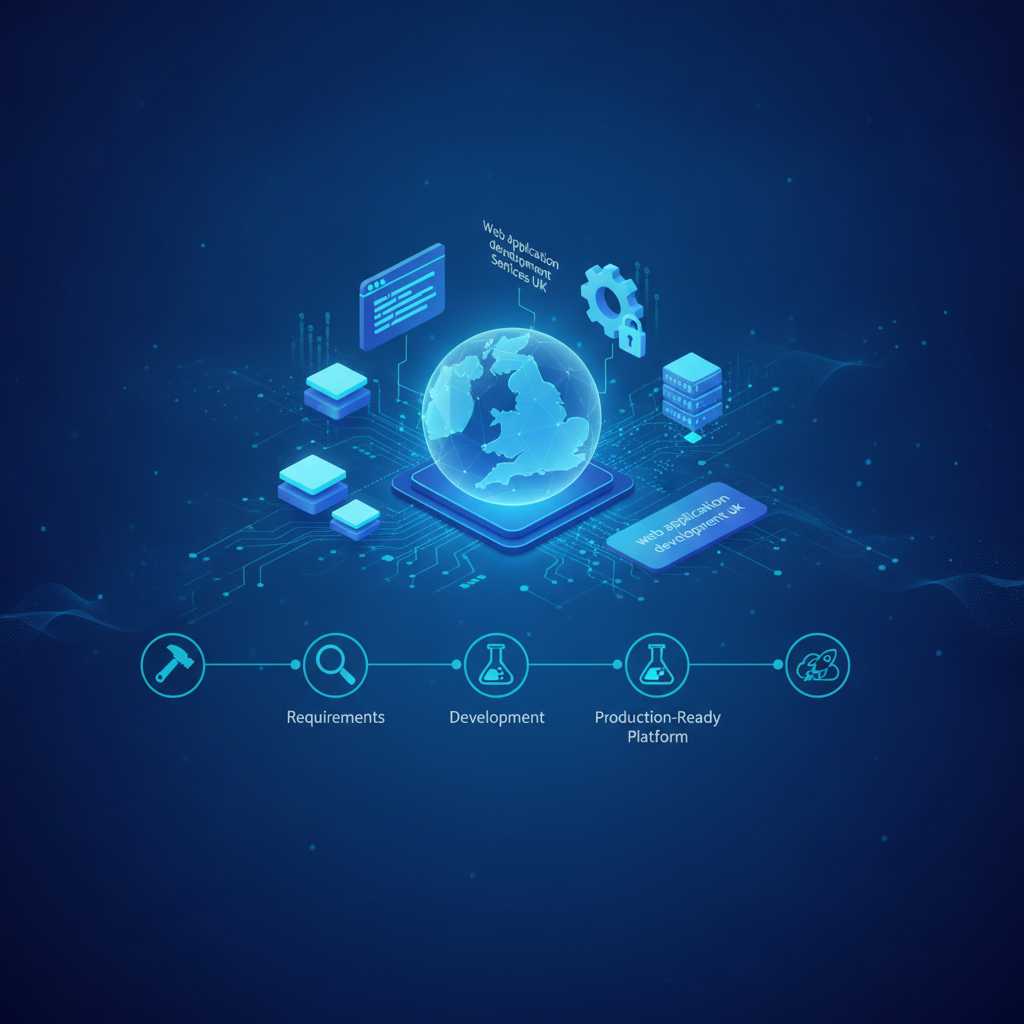
Web application development services cover the complete cycle of designing, building, integrating, and deploying a browser-based software application for your business — whether that is an internal operational tool, a customer-facing platform, a B2B SaaS product, or a data-driven dashboard. A professional web application development services provider takes end-to-end responsibility: from translating your business requirements into a technical architecture, through frontend and backend engineering, to deployment, monitoring, and ongoing maintenance.
The distinction between a web application and a website matters. A website delivers content. A web application processes data, enforces business logic, manages user state, integrates with external systems, and scales with your operational workload. Building one correctly requires a different discipline from web design or content publishing — it requires software engineering, system architecture, and operational maturity. UK businesses that treat a web application project like a website project typically end up with a system that works at launch and breaks under load or change.
What Custom Web Application Development Covers
A custom web application development engagement typically covers six distinct workstreams, each requiring specific expertise.
Requirements and architecture. Before any code is written, a professional development services provider translates your business requirements into a technical architecture document: database schema, API design, frontend component model, integration points, and deployment topology. This document is the contract between your business requirements and the engineering team's output. Without it, scope creep and rework are inevitable. Our technical consulting service covers this phase as a standalone engagement for businesses that already have development capacity but need architecture guidance.
Backend API development. The backend is the business logic layer — the rules, workflows, and data processing that define what your application actually does. A REST or GraphQL API exposes this logic to the frontend, to mobile clients, and to third-party integrations. A well-designed API is versioned, documented, authenticated, and built to handle the load patterns your business will experience as it grows. Our API development service covers design, build, documentation, and integration testing.
Frontend development. The frontend is the interface your users interact with — built in React, Vue, or another modern framework, designed in Figma, and implemented to be responsive, accessible, and performant across devices. A professional web application development services provider treats frontend code as production software, not a visual wrapper. Component architecture, state management, API integration, error handling, and loading states are all first-class engineering concerns. Our Figma to code service implements pixel-perfect frontend from your design files.
Database design and data architecture. Your data model is the hardest thing to change after a system is in production. Schema choices, indexing strategy, normalisation decisions, and data partitioning approach all determine how your application performs under load. A web application built on a well-designed data architecture scales cleanly. One built on a rushed schema becomes a performance constraint and a maintenance burden. Read our scalable software architecture guide for the principles behind sound data model design.
Third-party integrations. Almost every web application needs to connect to external systems — payment processors, CRM platforms, email and notification services, analytics tools, ERP or accounting software. A complete web application development services engagement designs these integrations as part of the initial architecture, not as afterthoughts bolted on later. Our software integration strategies guide covers the patterns for building integrations that remain maintainable as external APIs evolve.
Deployment and infrastructure. A production web application requires a deployment pipeline, a hosting environment, monitoring, alerting, and a backup strategy. Modern web application development services use cloud infrastructure — typically AWS, GCP, or Azure — with containerised deployments, managed databases, and CI/CD pipelines that enable reliable, repeatable releases. Our DevOps and cloud service handles this entire layer, from initial infrastructure design to ongoing operational management.
How to Evaluate Web Application Development Services in the UK
The UK market for web application development services spans everything from independent freelancers to enterprise consultancies. Choosing the right partner for your project requires asking the right questions at the evaluation stage.
Can they show production web applications at a similar scale to yours? Ask specifically about the database size, concurrent user count, and daily transaction volume of systems they have built and maintained. A provider that has only built low-traffic tools will not have the architecture instincts to design your high-traffic platform correctly.
Who builds the application — employed engineers or contractors? Many UK agencies act as brokers, outsourcing builds to offshore contractors and presenting as a domestic agency. Ask directly: are the engineers who will build my application employed by you, and will the same team maintain the application after launch? Consistency of team is a strong predictor of code quality and post-launch reliability.
What does the architecture process look like before build begins? Any credible web application development services provider should produce a written architecture document before any code is written. If a provider moves straight from a requirements call to a build estimate with no architecture phase, that is a red flag — either they are under-pricing the project by skipping a critical phase, or they will design as they build, which produces unmaintainable systems.
How is the project priced and what does scope change cost? Fixed-price delivery against a well-scoped architecture document is the gold standard. Time-and-materials for the build phase transfers the risk of under-estimation entirely to you. Most professional web application development services providers price discovery and architecture at a fixed fee, then provide a fixed-price build proposal after the architecture is finalised.
What does post-launch support look like? A web application is not a deliverable — it is a running system. Ask about SLA response times, monitoring and alerting coverage, how the provider handles third-party API changes, and whether there is a retainer model for ongoing feature development. A provider that does not have a clear post-launch support model is likely to be unavailable when you need them most.
Custom Web Application Development: In-House vs Agency
UK growth businesses frequently consider whether to build an internal development team or engage a custom web application development agency. The honest answer is that the right choice depends on the nature of the work and where you are in your growth curve.
An in-house team makes sense when the web application is central to your product — when you are building a SaaS product or a platform that will require continuous, rapid feature development and the software is your primary competitive asset. In this scenario, the institutional knowledge that accumulates in an in-house team is worth the overhead of hiring, management, and employment costs.
A custom web application development agency makes sense when the application is a tool for your operations — a client portal, an internal workflow system, a data dashboard, an integration platform — rather than your core product. In this scenario, you need the application built and running reliably, but you do not need a permanent internal team with the overhead that entails. A professional agency delivers the system, maintains it, and evolves it as your requirements change — with predictable cost and without the recruitment risk of hiring a senior development team. Our custom software ROI guide covers the financial modelling for this decision in detail.
What Custom Web Application Development Costs in the UK
UK pricing for custom web application development services in 2026 covers a wide range, and the variation is mostly a function of scope and integration complexity rather than quality alone.
- Internal tool or workflow application (single team, straightforward data model): £8,000–£25,000. Covers architecture, backend API, frontend, one or two integrations, deployment, and 12 months of support. Typical timeline: 6–10 weeks.
- Customer-facing web application (multi-user, role-based access, complex workflows): £20,000–£60,000. Includes advanced data architecture, multiple integration points, frontend design and implementation, testing, deployment, and ongoing maintenance. Typical timeline: 10–18 weeks.
- SaaS platform or B2B product (multi-tenant, subscription billing, third-party marketplace integrations): £50,000–£150,000+. Full product engineering engagement including architecture, build, QA, performance testing, and operational infrastructure. Typical timeline: 16–32 weeks.
Every engagement we run is fixed-price after a scoped discovery and architecture phase. This protects both parties — you know exactly what you are paying before build begins, and we have the architecture clarity to deliver on time.
Getting Started With Web Application Development Services
If you are planning a web application for your UK business — whether a new build, a legacy modernisation, or a platform expansion — the most valuable first step is a scoped technical discovery. This is not a sales call. A proper discovery session produces a clear technical architecture, a fixed-price build proposal, a realistic timeline, and an honest assessment of the risks. It costs a fraction of the build phase and eliminates the uncertainty that causes web application projects to run over time and budget. Book a free solution architecture review and we will assess your requirements, recommend an architecture, and produce a fixed-price proposal for your web application development engagement. For further reading, see our scalable software architecture guide and our guide to choosing the right software development solution in 2026.
 End-to-End Custom Solutions
 Business Process Web Apps
 API Modernisation