Fixed Price vs Time & Materials: Structuring a UK Software Development Contract
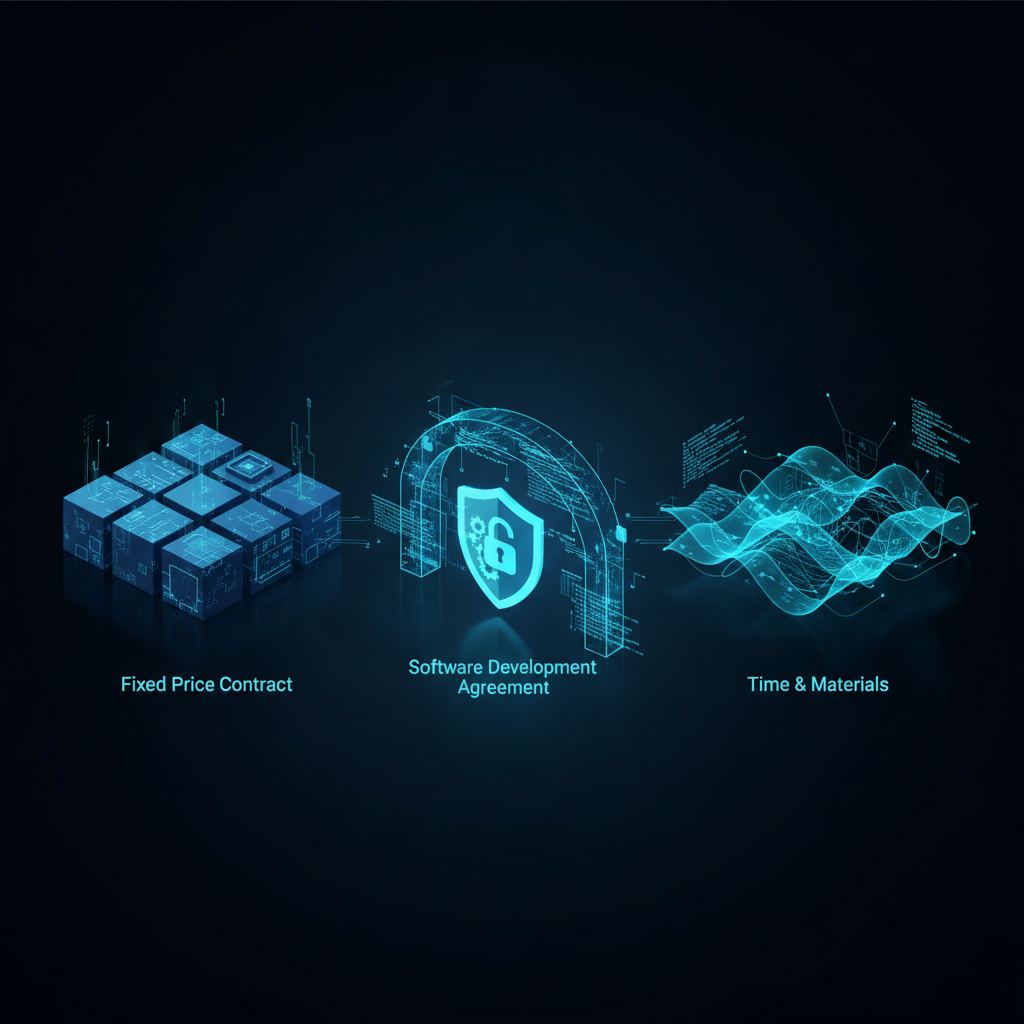
Why the contract model matters as much as the technical proposal
UK businesses evaluating software development solutions often spend weeks comparing technical approaches and almost no time on how the engagement will actually be billed and governed. That is a mistake — the contract model determines who carries the risk when requirements change, how disputes get resolved, and whether a provider is incentivised to finish quickly or to keep the meter running. Fixed price and time and materials (T&M) are the two dominant models, and picking the wrong one for your situation is a common source of budget overruns and delivery disputes.
Fixed price: what it actually protects you from
A fixed price software development contract sets a single price for a defined scope, agreed before work begins. It shifts scope-estimation risk onto the provider: if the work takes longer than estimated, the provider absorbs the cost, not you. This only works well when the scope is genuinely well-defined — which means a paid discovery phase before the fixed price is quoted, not a rough estimate from a sales call.
- Best for: well-understood projects with a clear specification — a defined integration, a migration with a known source and target, a feature set that does not depend on user research to finalise.
- Risk to watch: providers who quote fixed price without a proper discovery phase tend to pad the estimate heavily to cover their own uncertainty, or cut corners on quality once the fixed budget is exhausted. A fixed price without a documented, signed-off scope document is not really fixed — it is a starting point for change-request disputes.
Time and materials: what it actually protects you from
A time and materials contract bills for actual hours worked at an agreed rate, with no fixed total. It shifts the risk the other way: you carry the scope-estimation risk, but you gain the ability to change direction as you learn — which matters enormously for projects where requirements are genuinely uncertain at the start.
- Best for: new product development where user feedback will change the roadmap, projects with meaningful technical uncertainty (unfamiliar third-party APIs, unclear legacy system behaviour), and ongoing development relationships rather than one-off builds.
- Risk to watch: T&M without a capped budget and regular reporting can drift. The protection is not the contract type itself — it is transparent time tracking, a not-to-exceed cap with an explicit process for raising it, and sprint-level visibility into what was actually built.
The hybrid model most experienced providers actually recommend
In practice, the strongest structure for most engagements is hybrid: a fixed-price discovery and architecture phase (typically two to four weeks) that produces a detailed scope and an architecture decision record, followed by either a fixed price for the now well-defined build phase, or a capped time and materials arrangement with sprint-level reporting if genuine uncertainty remains. This sequencing avoids the two most common failure modes — a fixed price quoted without real discovery, and an open-ended T&M engagement with no visibility into whether the budget is on track.
Our technical consulting service runs this discovery phase as a standalone, fixed-price engagement, so you have a concrete scope and cost basis before committing to either contract model for the build itself.
Questions to ask before signing either contract type
- Was the fixed price quoted after a paid discovery phase, or from a sales conversation alone?
- For T&M, is there a not-to-exceed cap, and what is the process for raising it if scope grows?
- How are change requests priced and approved under each model?
- What reporting do you receive — sprint demos, time logs, burn-down against budget — and how often?
- Who owns the intellectual property, and is that stated the same way regardless of contract model?
Frequently Asked Questions
Is fixed price always cheaper than time and materials?
Not necessarily. A fixed price includes a risk premium the provider builds in to cover estimation uncertainty. For well-scoped work that premium is small; for poorly-scoped work quoted without discovery, it can be substantial — and you pay it regardless of whether the risk materialises.
Can a contract switch from time and materials to fixed price partway through?
Yes, and it is common: many engagements start T&M during discovery and uncertain early build phases, then move to fixed price once the scope stabilises and a detailed specification exists.
What software development contract structure do UK growth businesses use most often?
Most of our UK growth-business clients use the hybrid model — a fixed-price discovery phase followed by either a fixed price or capped T&M build phase — because it balances cost certainty against the flexibility that real product development requires.
Not sure which contract model fits your project? Book a free scoping session and we will recommend the right structure based on how well-defined your requirements actually are today.
 End-to-End Custom Solutions
 Business Process Web Apps
 API Modernisation